F2: How does advertisers use colors to influence their audience?
Colors appear in our everyday life and in everything we have interactions with. Often, colors are studied to find out the influence colors have on our behaviors, in retail and marketing, physical health and food preference.
 According to Psychology Professors from University of Rochester and University of Munich, Andrew J Elliot and Markus Ameir, “different colors have different associations, and viewing a color is thought to trigger psychological responses consistent with these associations.” (Elliot, and Maier, 250). Applying this general idea of colors to the advertisement and marketing world, there are far more relation between colors and how it influences our thoughts about the product presented in the advertising.
When advertisers seek to sell their products successfully, they look for a way that will visually impact the consumers thoughts. In the advertising world, colors is known as a visual tool to grasp the consumers first impression. It is essential to ensure that the advertisement is capable of grasping a positive first impression from the consumers, otherwise, it’ll be a struggle to successfully sell the product to consumers (Visual Impacts). Moreover, it is extremely important for ad creators and designers to choose colors carefully. Determining how colors should interact and how colors should combine with one another highly impacts the result of how well the advertisement is able to sell to their audience. In the marketing world, it is essential to choose the right color in order to ensure that the audience will purchase the product. Colors play a significant role in how well your brand will be recognized by consumers and how high of a chance your products will have successful sales. (Visual Impacts). The first component designers need to pay attention to is the intended audience. Color choice varies depending on which group of audience you are trying to influence. According to Satyendra Singh, an Associate Professor at University of Winnipeg, he conducted research on impact of colors on marketing and proposed that “ use of colors can contribute not only to differentiating products from competitors, but also to influencing moods and feelings – positively or negatively –and therefore, to attitude towards certain products. Given that our moods and feelings are unstable and that colors play roles in forming attitude, it is important that managers understand the importance of colors in marketing.” (Singh, 783).
 When consumers are deciding whether or not they want to buy a certain product, majority of their decision is based on the color because color promotes a strong and persuasive cue to the consumers. According to Drew Coffin, an editorial coordinator form “Web Marketing Today”, and an experienced graphic designer, consumers rely on three different factors to help them decide whether or not the product appeals to them. These three factors are sound/smell, texture, and visual appearance. And in statistics, only 1% of consumers place their attention on the sound/smell of the product, 6% on the texture, and 93% on the visual appearance. (Coffin). Adding on, the importance of colors not only impact the marketing of the product, it also has an impact on brand recognition. There are always competitors out there competing to win consumers confidence and trust. Thus, aside from having a good selling product, it is also important to have a strong, unique brand logo that can be easily recognized by the consumers even after their first impression (visual impacts).
With an understanding of color associations and meanings, it can help ad designers determine what colors they should use in order to attract the right audience. Drew Coffin, an editorial coordinator for “Web Marketing Today” and an experienced graphic designer who studied integrated marketing communication in University of Idaho, assigned each color with an explanation telling us what the meaning is associated with each color. In addition, he explains how each color impacts our emotions. According to Zena O'Connor, a researcher of environment-behavior studies group, faculty of architecture, design and planning in University of Sydney, “symbolic colour associations and colour meanings are often mentioned in conjunction with a range of psychological responses to colour including affect,preference, and cognitive judgements; and these in turn are often commingled with biological and behavioral responses to colour.” (Connor, 231).
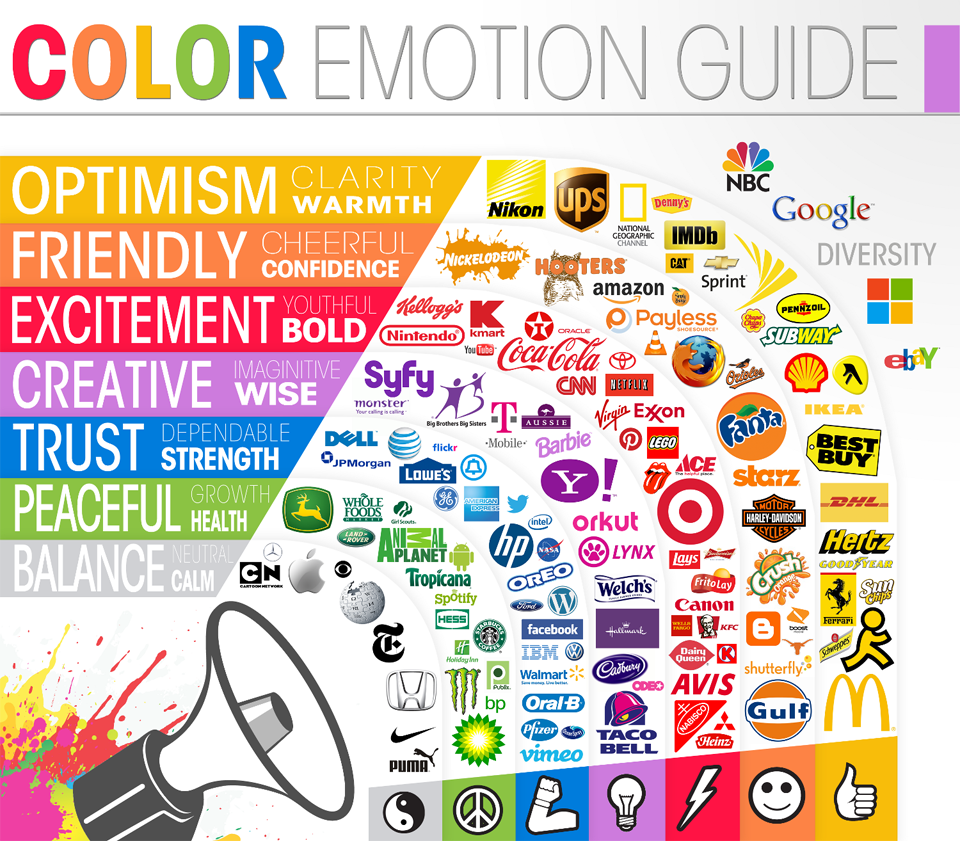
 The most common and basic colors used in advertisements are the colors red, orange, blue, green, purple, pink, white black, gold and silver. Starting off with red, it is associated with the meanings of “energy, excitement, love, strength and passion,” (Visual impact). It is a warm tone color that evokes strong emotions and feelings. But on the negative side, red can also derive the meanings of violence, anger, and aggression. Sales and Clearance is a great example of how the color red affects our purchases. Retailers purposely choose the color red as a tool to set up sales and clearance signs.
The redness of the sign is easy to spot and creates a feeling of urgency and energy (Advertising). If you were shopping in a clothes store, the psychology of colors will make you walk towards the section with bright red signs because people often feel the urge to save money during purchases. Or as an universal example, the stop sign is designed to be in color red because it cause people to feel urgent and be alert. On the other hand, the color orange associates with the meaning of friendly, cheerful, confidence, warmth and enthusiasm. (Connor, 231). Great examples of orange logos is the Nickelodeon, fanta, Crush and payless (Advertising).

Blue is one of the most common color choice to use in advertisements and logo designs. Blue brings the message of trust, dependable, and security. In the technology world, companies like AT &T, Facebook, hp, American Express, JP Morgan, vimeo, Twitter, etc. all use the color blue in their logo design. (“visual impact”). Many people might not understand why the color blue is so common in logos. Based on the meaning it is associated with, the reason why credit card companies/banks, social network companies use the color blue is because it wants the consumers to feel a sense of trust and security when using their network. It influences the consumer psychologically in order to obtain reliability and credibility (Visual Impacts). The color green is also used in many companies as well. Companies like Tropicana, wholefoods, Monster, use the color green as their dominant concept of selling (Coffin). As you can see, they share a common selling purpose. They all fall in the food preference category. In terms of food, it is essential for the seller to make the consumers feel comfortable and safe consuming the product. The color green is associated with calm, peaceful and health (Coffin). In the psychological perspective, the color green is one of the most relaxing color because other colors are either too vibrant or too dull (visual impacts).Green is often linked with nature and the environment (visual impacts). Thus, businesses that focus on environmental living and sustainability rely on the color green. As an example, Clorox uses green to promote its organize cleaning product. The fluid of the product itself is also the color green. On its website, the homepage is dominated with the color green because it is trying to promote a product that it related to nature, and environment. Thus, to ease the feelings of the consumers, making the product and ad green makes consumers feel a sense of peace and nature. (Drew Coffin, “Color Psychology and ECommerce”). Another important color that is commonly used in modern advertisements and logos is the color grey. Grey brings the message of neutral, calm and balance. Wikipedia, Apple, Honda are examples of companies that use the grey concept as part of their selling (Coffin).
 Altogether, each individual interprets each color differently and color association often varies from culture to culture. However, in advertising and marketing world, companies with similar concepts use similar colors to help sell their products to the consumers. Thus, people are often influenced by the visuals portrayed by the advertisers.
Works Cited
"Advertising & Marketing-Visual Impact Systems | The Psychology of Color - Advertising & Marketing-Visual Impact Systems." Advertising MarketingVisual Impact Systems RSS2. N.p., n.d. Web. 14 Nov. 2013.
Singh, Satyendra. “Impact of color on marketing.” Management Decision. Vol. 44 No 6. Emerald Group Publishing Limited, 2006. pp.786-789. Print.
Elliot J. Andrew, Maier A. Markus. “Color and Psychological Functioning.” Association for Psychological science. 2007. pp 250-254. Print. http://www.psych.rochester.edu/research/apav/publications/documents/2007_ElliotMaier_ColorandPsyFunct.pdf
Coffin, Drew. "Color Psychology and Ecommerce » Web Marketing Today." Web Marketing Today. N.p., n.d. Web. 14 Nov. 2013.
Connor, Zena O' "Join Academia.edu & Share Your Research with the World." Colour Psychology and Colour Therapy: Caveat Emptor (2011). N.p., n.d. Web. 14 Nov. 2013.
Images:
"Colour Affects." Colour Affects. N.p., n.d. Web. 13 Dec. 2013. <http://www.colour-affects.co.uk/>.
"How Do Colors Affect Purchases?" Infographic. N.p., n.d. Web. 15 Dec. 2013. <http://blog.kissmetrics.com/color-psychology/>.
http://images.huffingtonpost.com/2013-01-20-Color_Emotion_Guide22.png


Colors impact on our final decisions, don't you, guys, think so? What usually makes you to buy an item colored in red or yellow? It is all about psychology! http://skywritingservice.com/blog/impact-of-color-psychology-on-us
ReplyDelete